
Main points
The devolved nature of UK housing policy means that data on housing stock, including empty homes, are defined and recorded differently between England, Wales, Scotland, and Northern Ireland. In terms of comparability, statistics on:
- the overall percentage or number of empty homes (derived from data) can be broadly compared across England, Wales, and Scotland
- the overall percentage or number of empty homes (disaggregated by Council Tax band) can be broadly compared between England and Scotland only (whilst noting the relevant caveats)
- housing stock recorded as vacant in Northern Ireland (derived from domestic rates data) cannot be compared with empty homes statistics (derived from Council Tax data) from England, Wales, and Scotland – this is because of differences in the legislative frameworks governing domestic rating and Council Tax
When the data are analysed, we can see that:
- the percentage of dwellings recorded as being empty for more than 6 months within Council Tax data has remained relatively stable in England, Wales, and Scotland, since 2021
- in 2025, the highest percentage of dwellings recorded as being empty for more than 6 months within Council Tax data were in Bands A and H in both England and Scotland
- in 2025, the highest percentage of dwellings recorded as being empty for more than 6 months within Council Tax data were in Band A in Wales
- the percentage of housing stock recorded as vacant within domestic rates data has remained relatively stable in Northern Ireland between 2016 and 2025
This article has been produced by the Office for National Statistics (ONS) Government Statistical Service (GSS) Coherence Team, in partnership with:
- the Ministry of Housing, Communities and Local Government (MHCLG)
- Scottish Government
- National Records of Scotland (NRS)
- Welsh Government
- the Department for Communities (DfC) Northern Ireland
- Action on Empty Homes
This article is part of a cross-government approach to improve the coherence of empty homes statistics from across the UK and our understanding of the trends these data show over time.
This article brings together:
- empty homes statistics (which are derived from Council Tax data) from England, Wales, and Scotland, collected between 2015 and 2025
- statistics on housing stock recorded as vacant (which are derived from domestic rates data) from Northern Ireland, presented as annual snapshots for the period 2016 to 2025
By bringing these statistics together, this article aims to provide information to help data users:
- compare data, where appropriate
- understand where comparisons cannot be made
Why empty homes statistics are collected
The statistics discussed in this article are collected in England, Wales, Scotland, and Northern Ireland to identify unused housing stock. A clear understanding of their comparability can help to assess the extent to which empty dwellings could help meet housing demand across the UK.
A dwelling is a self-contained unit of residential accommodation that someone can live in. It may be occupied, or capable of being occupied.
The ONS published an article titled “Comparing empty home statistics in England and Wales” which outlined the different official statistics on empty homes in England and Wales. It also explained the strengths and limitations associated with each data source.
This article assesses the statistical coherence of empty homes statistics (derived from Council Tax data) and statistics of housing stock that are recorded as vacant (derived from domestic rates data). These data sources have been selected because they provide a consistent and long-running time series of housing availability.
Council Tax
Council Tax is a mandatory banded local property tax paid by households on domestic properties in England, Wales, and Scotland to fund local public services like waste collection, social care, and education-related services.
A property is a physical asset that includes the building structure and any associated land. It can be residential or non-residential and may contain one or more dwellings.
As housing is a devolved system, England, Wales, and Scotland have their own, separate, Council Tax rules and rates. Empty homes statistics produced from Council Tax data in England, Wales, and Scotland are published by the MHCLG, Welsh Government, and Scottish Government, respectively.
Domestic rates
Domestic rates are a property tax paid by households in Northern Ireland. Revenue raised through the domestic rating system contributes to the funding of central and local government services. LPS is responsible for a wide range of property related services, including the billing and collection of rates. LPS publishes statistics on housing stock recorded as vacant within the LPS rating system.
Exemptions
There are differences across the four countries of the UK as to whether owners of newly empty homes can receive any initial exemption for Council Tax (in England, Wales, and Scotland) or domestic rates (in Northern Ireland). Overall, this can affect how data can be compared between countries, or whether it can be compared at all.
England, Wales, and Scotland
Owners of empty homes in England, Wales, and Scotland are exempt from paying Council Tax in certain circumstances where the vacancy is unforeseen or unavoidable. Examples include where the sole resident:
- is in prison
- is in hospital receiving care and treatment
- is living permanently in a care home
- has had the property repossessed
Further to this, in England, Wales, and Scotland, if the sole resident of an empty home has died then the home will be exempt from Council Tax until a Grant of Probate (in England and Wales) or a Grant of Confirmation (in Scotland) is issued. It will remain exempt for a further 6 months after the Grant is issued.
Northern Ireland
In Northern Ireland, if a deceased person was the sole owner and occupier of a property, their personal representative becomes responsible for the administration of the estate, which includes paying rates. However, the personal representative can apply for an exemption while the property is in probate, provided it is unfurnished and not used for storage.
In addition, in Northern Ireland, owners of vacant domestic properties do not have to pay rates if the property has a capital value below £20,000. There is no equivalent rule in England, Wales, and Scotland, where all dwellings are assigned to a Council Tax band based on their value.
Read guidance on the implementation of the council tax premiums on long-term empty homes and second homes by the MHCLG. This provides additional information on Council Tax premiums on long-term empty homes in England, as well as on exceptions to these premiums.
What we mean by an 'empty home'
There are differences in how an ‘empty home’ is defined within Council Tax data across England, Wales, and Scotland. Northern Ireland does not currently collect data on ‘empty home’. Instead, data on ‘housing stock recorded as vacant’ is available through information provided by ratepayers to LPS. These definitional differences can affect how or whether data can be compared between countries.
England
In England, an ‘empty home’ is defined for the purposes of Council Tax, and within Council Tax data, as a dwelling which is “unoccupied and substantially unfurnished”. Within Council Tax data published by the MHCLG, a ‘long-term empty home’ is where the dwelling has been unoccupied and substantially unfurnished for more than 6 months.
Wales and Scotland
In Wales and Scotland, an ‘empty home’ within Council Tax data is also defined as a dwelling which is “unoccupied and substantially unfurnished”, however this must be for a period longer than 6 months. A ‘long-term empty home’ is a specific subset of this where the dwelling has been unoccupied and substantially unfurnished for more than 12 months.
Northern Ireland
In Northern Ireland, ‘housing stock recorded as vacant’ within the domestic rates data from the LPS rating system is defined as properties which are valued as domestic or mixed for the purposes of rating as a dwelling, and which are recorded as vacant.
Incentives to bring empty homes back into use
In England, Wales, and Scotland there are financial incentives to encourage owners to bring unused housing stock back into use. However, how these incentives are applied varies between the countries and even between local councils.
In Northern Ireland, there are currently no financial incentives to specifically bring empty homes back into use. However, there is a requirement for owners to pay the full domestic rate, even if their property is vacant, which incentivises owners to keep their properties occupied. The DfC Northern Ireland is currently planning a small pilot project in three local government districts which aims to map vacancy and inform policy options to bring empty homes back into use.
These differences across the UK can affect data comparability. It is important to consider financial incentives that aim to bring empty homes back into use when analysing data trends on the number of empty homes, as they may affect both how properties are reported and how actively local authorities identify them.
Premiums
In England, Wales, and Scotland, individual councils have discretion to set and charge their own Council Tax premiums on long-term empty homes, on top of the Council Tax rate, to incentivise owners to bring them back into use. Local councils in England may offer Council Tax discounts at their discretion. In addition, local authorities can charge additional premiums on empty homes once a vacancy becomes long-term. In England, Scotland, and Wales, individual councils can choose the level of the premium (up to the applicable maximum in England and Wales; there is no maximum in Scotland).
For example, from 1 April 2013, English local authorities were given the discretion to introduce a premium charge of up to 50% on dwellings which have been empty for more than 2 years. Over time, the maximum premium has increased and the time from when the premium could be charged has decreased from 2 years to 1 year. As of 1 April 2024, the following premiums can be charged:
- up to 100% on dwellings which have been empty between 1 and 5 years
- up to 200% on dwellings which have been empty between 5 and 10 years
- up to 300% on dwellings which have been empty for over 10 years
In comparison, from 1 April 2026, a national default premium of 100% was established across Scotland on dwellings that have been empty for more than 1 year. Local authorities can choose to:
- set premiums for long-term empty homes above or below the national default premium
- apply no premium
- apply a discount
Finally, from 1 April 2017, Welsh local authorities were given the discretion to introduce a premium charge of 100% on dwellings that have been empty for more than 1 year. From 1 April 2023, the premium charge was increased to a maximum of 300% on dwellings which have been empty for more than 1 year.
Other incentives and programmes
Several other incentives and programmes exist across the UK to help bring empty homes back into use. Examples of these include:
- a reduced VAT rate charge of 5% which is applicable on building materials and labour for the renovation of dwellings which have been empty for at least 2 years (compared to the normal 20% VAT rate) – for dwellings that have been empty for more than 10 years, a 0% VAT rate charge may be applicable on building materials and labour for renovation works
- Empty Homes Grant Schemes, offered by Welsh Government and certain local councils in Scotland – these schemes provide grants of up to £25,000 to renovate empty properties to make them suitable for residential use (subject to eligibility criteria)
- Houses into Homes – an interest free loan scheme funded by Welsh Government to renovate empty properties and make them safe to live in
- the Scottish Empty Homes Partnership – this is funded by Scottish Government and provides advice and support to council empty homes officers, homeowners, residents, and prospective buyers (including developers) on how to bring privately owned empty homes back into use
You may find the following resources useful:
- “Bringing empty homes back into use: an audit of privately owned empty homes in Scotland” by Scottish Government – this publication analyses the scale, characteristics and outcomes of privately owned empty homes in Scotland, examining how councils have used different powers and interventions to bring these properties back into use
- “Scottish Empty Homes Partnership Annual Report 2024 to 2025” by the Scottish Empty Homes Partnership – this report provides data on the numbers of empty homes brought back to use in Scotland through various financial initiatives
- “Bringing empty homes back in to use: approaches and interventions – an evidence scoping review” by Scottish Government – this review examines the range of policies, interventions and evidence on how empty homes can be brought back into use in Scotland, identifying what works, what is known, and where evidence gaps remain
Comparability of empty homes statistics
We assessed statistics on empty homes (from Council Tax data) and housing stock recorded as vacant (from domestic rates data) from the four countries of the UK and have concluded that:
- statistics on the overall percentage or number of empty homes (derived from Council Tax data) can be broadly compared across England, Wales, and Scotland
- statistics on the overall percentage or number of empty homes (disaggregated by Council Tax band) can be broadly compared between England and Scotland only (whilst noting the relevant caveats)
- statistics on housing stock recorded as vacant derived from domestic rates data from Northern Ireland cannot be compared with empty homes statistics derived from Council Tax data from England, Wales, and Scotland – this is due to differences in the legislative frameworks governing domestic rating and Council Tax
There are wider differences between the countries that should also be considered when interpreting empty homes statistics from each country. For example, you should consider:
- housing stock relative to population size and age (for example, consider whether areas with a shrinking or ageing population could have more empty homes)
- housing stock relative to the type of new housing being built, where they are being built, and how quickly they are being built (for example, consider whether areas with significant new-build development could be more popular and have fewer empty homes)
- housing stock relative to rurality (for example, consider whether rural areas have more low use or empty homes)
- house prices and affordability (for example, consider whether regional economic downturns could cause a spike in empty homes)
Analysis of empty homes data in England, Wales, and Scotland
The percentage of dwellings that have been empty for more than 6 months has remained relatively stable since 2021 in England, Wales, and Scotland.
Figure 1: Percentage of dwellings that have been empty for more than 6 months, England, Wales, and Scotland, 2015 to 2025
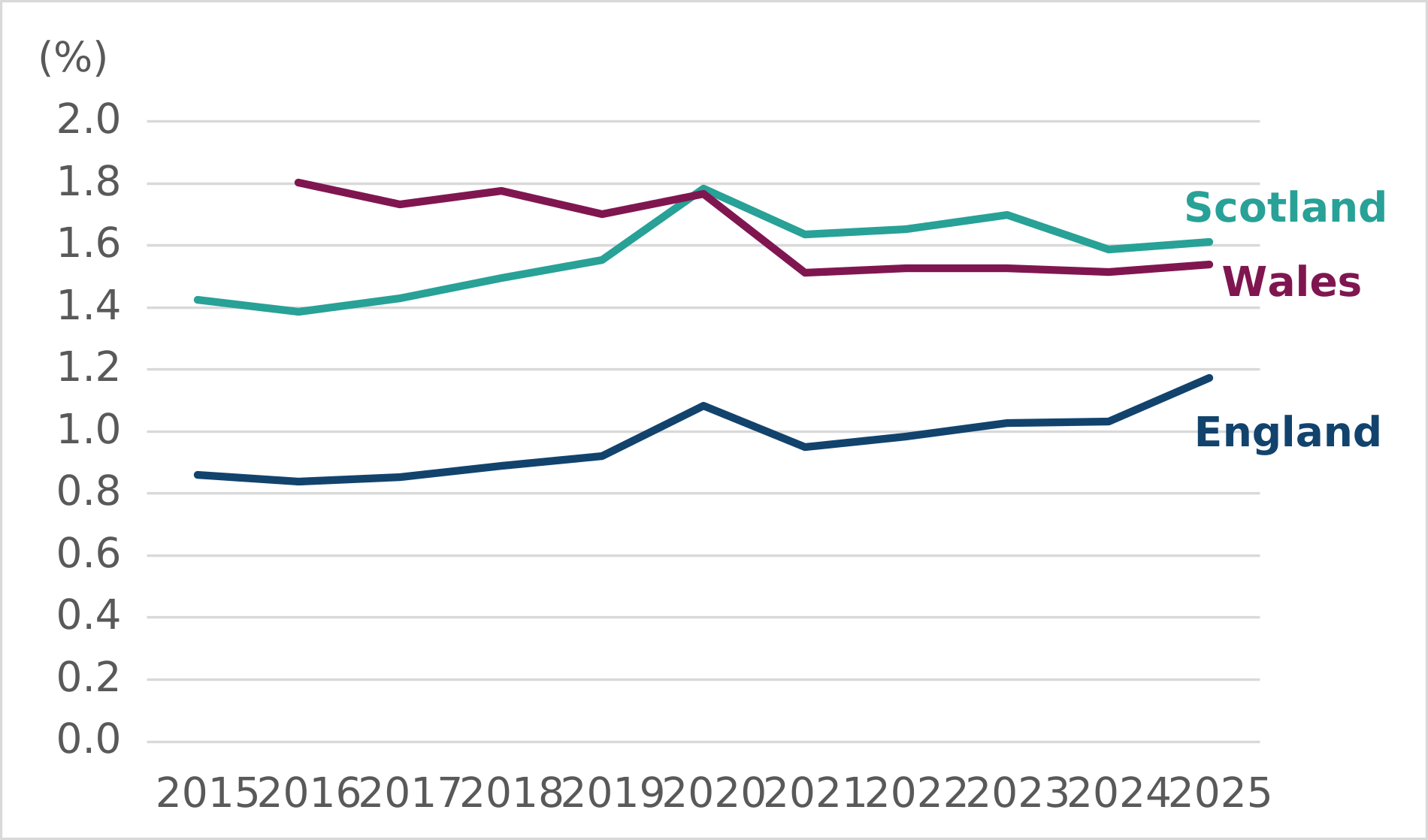
Figure 1 shows that, in 2025, 1.2% of all dwellings in England (303,185 dwellings) have been empty for more than 6 months. This is compared to 1.6% in Scotland (44,453), and 1.5% in Wales (23,033). While the proportion of empty homes within each country has remained relatively stable over time, it is important to note that the percentage change in the number of empty homes can be more variable, as they represent a small share of the total housing stock.
Sources:
- Live table 615 (ODS, 306KB) and Council Taxbase statistics from MHCLG
- Second Homes and Empty Properties from Scottish Government
- Council Tax Dwellings from Welsh Government
Notes on Figure 1
Council tax data on empty homes are collected as a snapshot in September or October of each year. In Wales, these data are labelled as the upcoming financial year when they are published. For consistency with other countries, we have expressed the date as the year it was collected.
The number of empty homes counted through Council Tax systems can fluctuate over time. This is due to changes in Council Tax liability policy and management information systems.
Guidance was strengthened in Scotland in September 2024 to ensure councils excluded properties that have been empty for less than 6 months from their data return. Some councils had previously included them, meaning earlier empty homes figures may be overstated – but it is not possible to quantify by how much.
In 2020, both England and Scotland saw an increase in the percentage of dwellings that had been empty for more than 6 months. The data for Wales showed a smaller increase (as seen in Figure 1). Within the “Second Homes and Empty Properties in September 2025” publication, Scottish Government explained that this increase in Scotland’s data was likely caused by the COVID-19 pandemic and the associated movement restrictions that affected both the property rental and sales markets.
Percentage of empty dwellings within Council Tax bands
Council Tax bands categorise residential dwellings into valuation bands. Local authorities set the amount of Council Tax paid annually by the owners of property within each Council Tax band. Data on the percentage of empty homes within each Council Tax band allows users to understand the type and value of empty housing stock.
England and Scotland have 8 Council Tax bands, labelled from A to H. Properties are assigned to a band based on their value as it was in 1991. In England and Scotland, Band A is assigned to the lowest value properties, whereas Band H is assigned to the highest value properties.
As England and Scotland use the same Council Tax band structure (although there are differences in their valuation bands as of 1991, and their multipliers used for bands E to H), we would assess their statistics as being broadly comparable – whilst noting the relevant caveats. Specifically, within the “Council Tax Rates: Comparing Scotland to other UK nations” article, Scottish Government make clear that “full comparability” of these statistics is not possible because England’s Council Tax bill contains additional elements, and there are special factors that are taken into account when setting Council Tax levels. Scottish government suggest that broad statistical comparisons can still be made on a case-by-case basis depending on whether the data can fulfil a specific purpose, however caution should be taken.
By contrast, Wales has 9 Council Tax bands. Properties are assigned to a band based on their value as it was in 2003. In Wales, Band A is assigned to the lowest value properties, whereas Band I is assigned to the highest value properties. Data from Wales cannot be compared with data from England and Scotland because Wales:
- uses a different Council Tax band structure to England and Scotland
- carried out their property valuations at a different time
England and Scotland
A larger percentage of dwellings in Bands A and H in England and Scotland are empty compared with other Council Tax bands.
Figure 2: Percentage of dwellings within each Council Tax band that have been empty for more than 6 months, England and Scotland, 2025
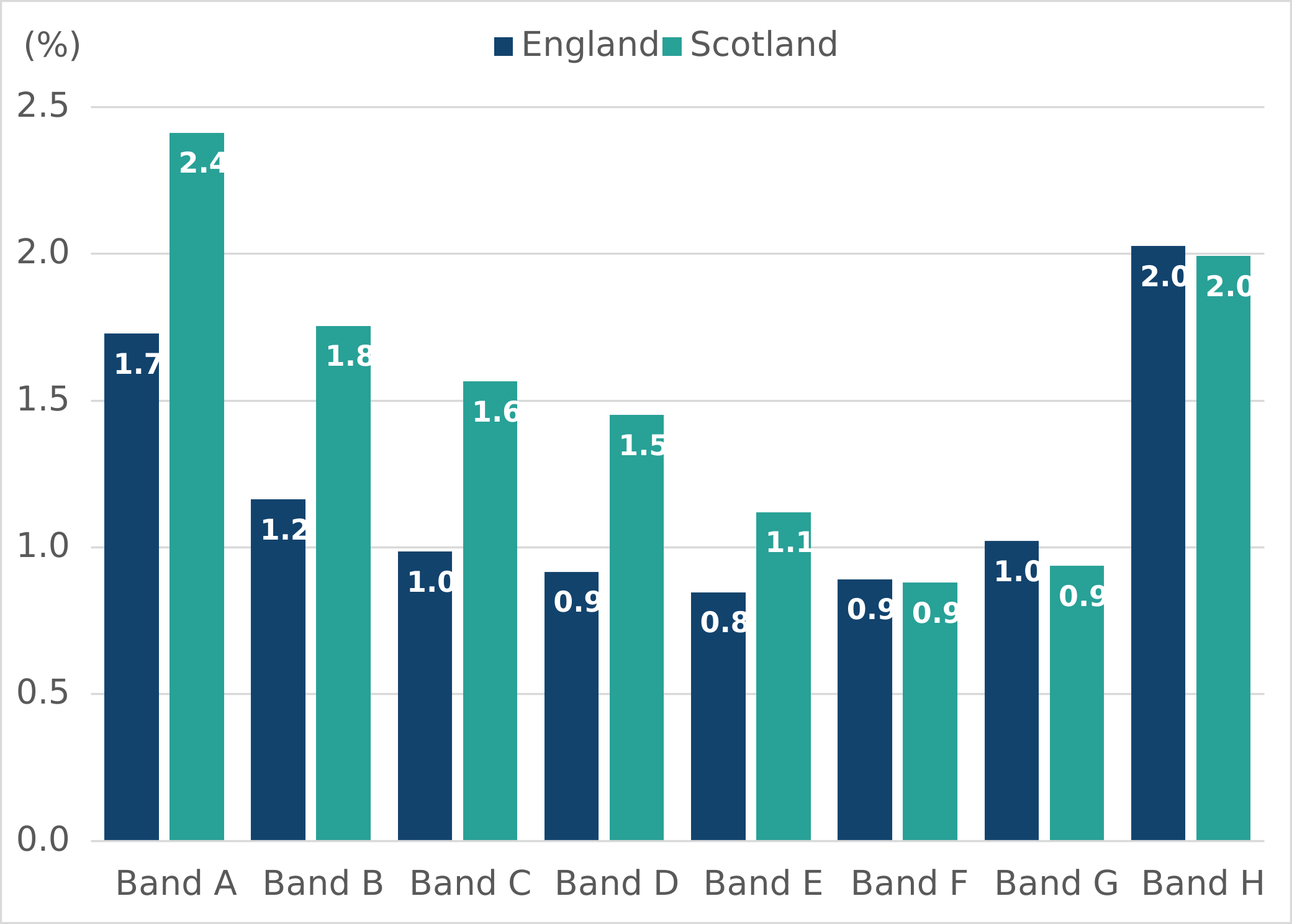
Figure 2 shows that, in 2025, dwellings empty for more than 6 months were most prevalent in Band A (1.7% in England; 2.4% in Scotland) and Band H (2.0% in both England and Scotland).
Sources:
- Council Taxbase statistics (XLSX, 1,758KB) from Ministry of Housing, Communities and Local Government (MHCLG)
- Scottish Government, CTAXBASE
Notes on Figure 2
Specific property values in the bands (and the multipliers used for bands E to H) differ between England and Scotland, but the band structure is still broadly comparable. The actual amount of Council Tax paid in each band differs between countries and local authorities.
The “Council Tax Rates: Comparing Scotland to other UK nations” article published by Scottish Government, states that in comparison to Scotland, the Council Tax bill in England contains additional elements and special factors are taken into account when setting Council Tax levels. Full comparability is therefore not possible, and caution should be taken when making statistical comparisons. However, as England and Scotland use the same Council Tax band structure, we would assess their statistics to be broadly comparable. Broad comparisons can still be made on a case-by-case basis depending on whether the data can fulfil a specific purpose.
In Scotland, guidance was strengthened in September 2024 to ensure councils excluded properties that had been empty for less than 6 months before their data return. Some councils had previously included them, meaning earlier empty homes figures may be overstated, but it is not possible to quantify by how much.
Wales uses a different Council Tax band structure to England and Scotland. This means data on the percentage of dwellings within each Council Tax band in Wales cannot be compared with data from England and Scotland.
It could be possible that the distribution shown in Figure 2 (that Bands A and H have the highest percentage of dwellings that have been empty for more than 6 months, in England and Scotland) is reflective of where vacancy pressures lie in the housing markets in these countries.
For example, Band A dwellings of lower value could have weaker rental or resale demand. By contrast, Band H dwellings with high-value investment assets could have more infrequent occupation. Together, these dynamics could mean both the lowest‑value and highest‑value Council Tax bands show a disproportionately higher percentage of empty homes.
Wales
A larger percentage of dwellings in Band A in Wales are empty compared with other Council Tax bands.
Figure 3: Percentage of dwellings in each Council Tax band that have been empty for more than 6 months, Wales, 2025
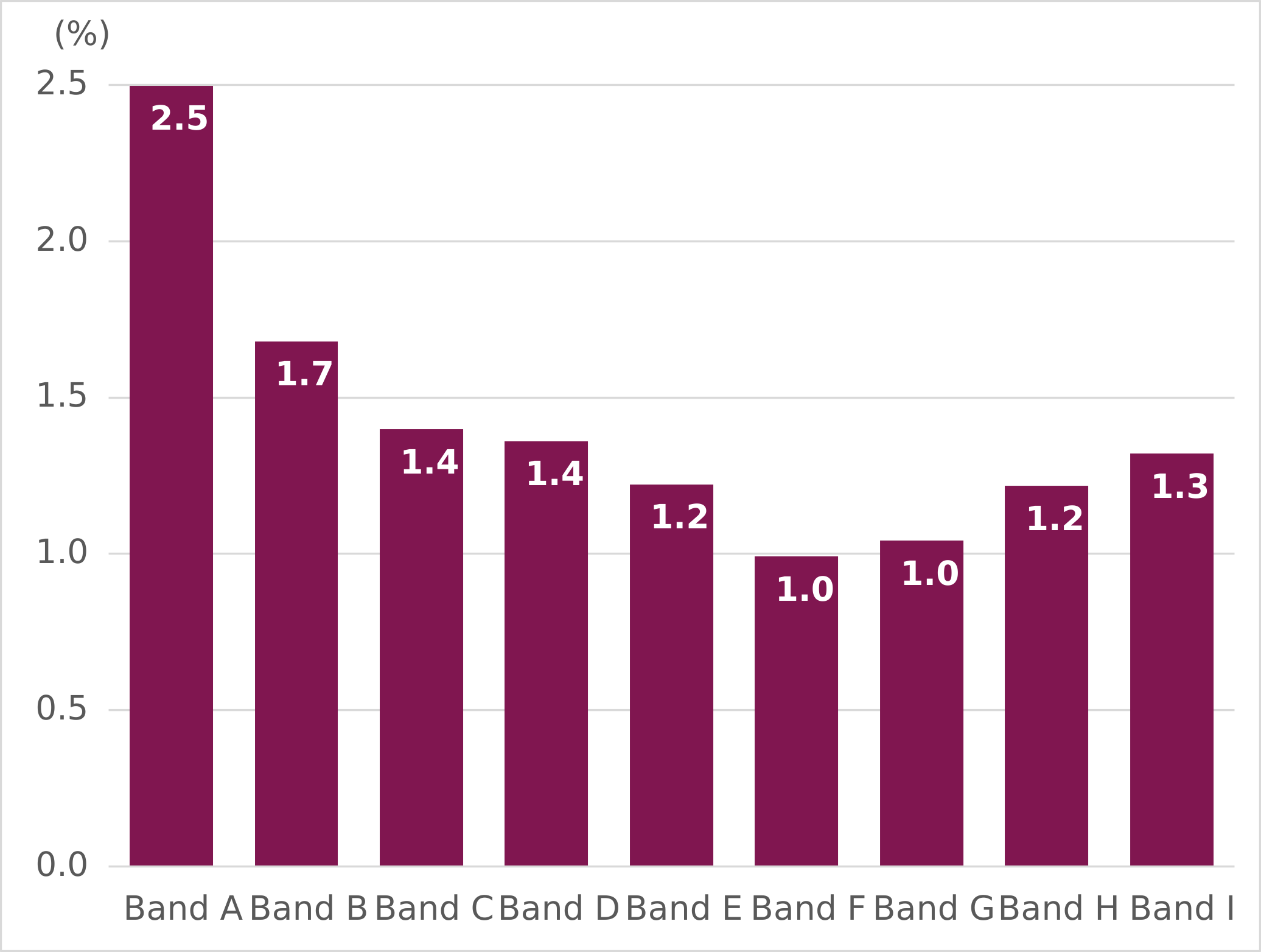
Figure 3 shows that, in 2025, the highest percentage of dwellings that have been empty for more than 6 months in Wales were in Band A (2.5%).
Source: Council Tax Dwellings by authority and band from Welsh Government
Notes on Figure 3
Wales uses a different Council Tax band structure to England and Scotland. This means data on the percentage of dwellings within each Council Tax band in Wales cannot be compared with data from England and Scotland.
In Wales, Council Tax data are labelled as the upcoming financial year when they are published. For consistency with other countries, we have expressed the date as the year it was collected.
In Wales, Band A homes are common in former industrial, coastal and rural communities where property values are lower and demand is weaker. This means these homes are more likely to become empty due to affordability issues, poor conditions, and limited rental demand.
The Bevan Foundation’s 2025 report titled “Understanding how taxes on land and property are used in Wales” stated that 49% of empty dwellings in the financial year of 2025 to 2026 were in Bands A and B, compared to 35% of all dwellings in Bands A and B. Only 8% of empty dwellings were in Bands F and above, compared to 13% of all dwellings in Band F.
Housing stock recorded as vacant in Northern Ireland
The percentage of housing stock recorded as vacant has remained relatively stable between 2016 and 2025 in Northern Ireland.
Figure 4: Percentage of housing stock recorded as vacant, Northern Ireland, 2016 to 2025
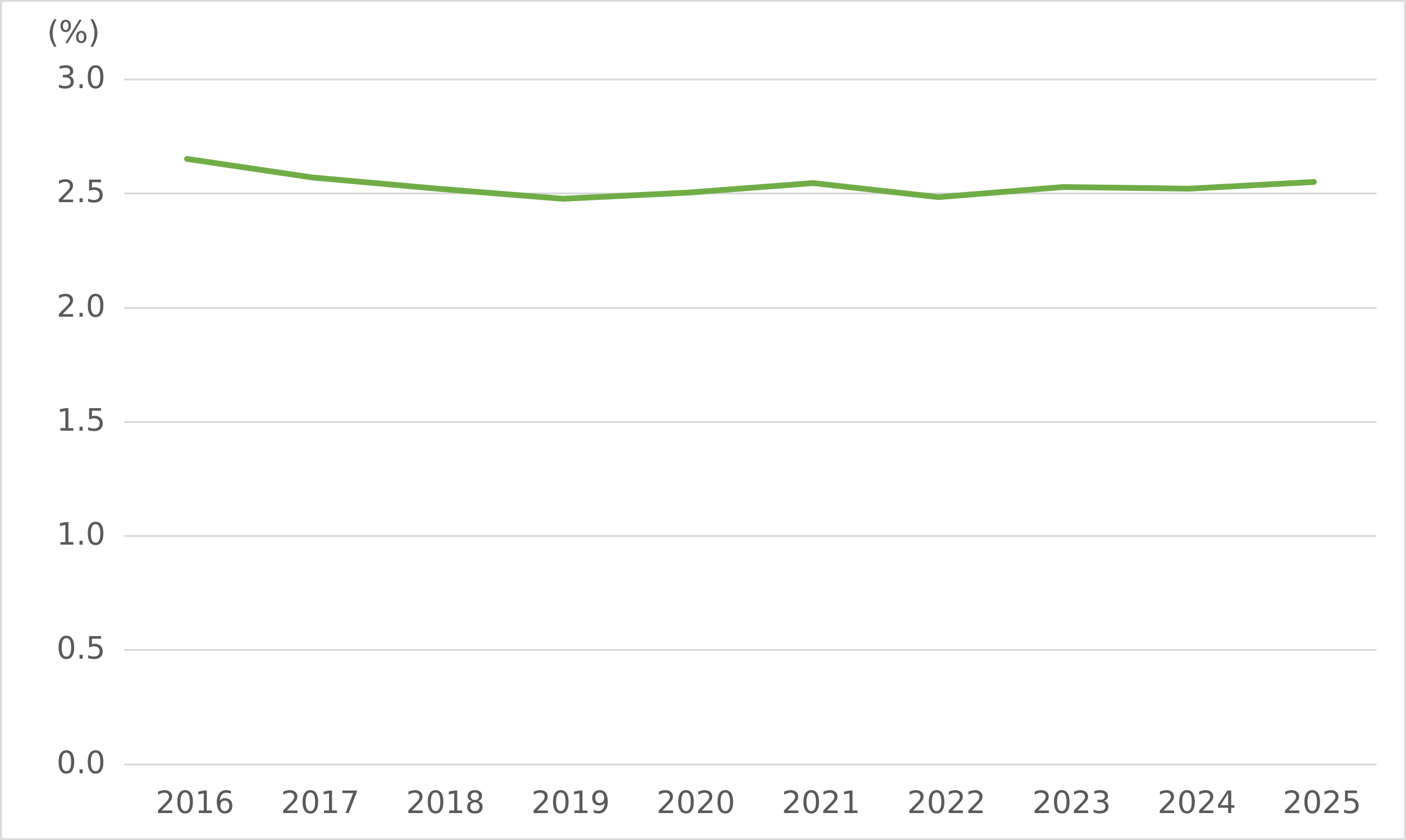
Figure 4 shows that, in 2025, 2.6% of all housing stock in Northern Ireland (21,472 properties) was recorded as vacant.
Source: Housing Stock, by District Council, recorded as vacant from Land & Property Services, Northern Ireland
Notes on Figure 4
The data refer to properties on the Valuation List at the start of each financial year, which are valued as domestic or mixed for the purposes of rating as a dwelling, and which are recorded as vacant.
The rate liability for housing stock recorded as vacant is assessed and billed at 100%, so there is currently no requirement for ratepayers to inform LPS that their property is vacant, unless applying for a rating exemption. As such, information in the rating system on domestic properties recorded as vacant may not be current or complete.
Housing Stock is defined as a count of properties which are valued as domestic or mixed for the purposes of a private dwelling. This excludes Caravans, Domestic Garages, Domestic Stores, and Car Parking Spaces.
Data on the number of housing stock recorded as vacant within the LPS rating system are published online, however these data reflect the status of properties as recorded at a specific point in time only.